Cybersecurity
Vector Databases Explained for UAE Technical Decision-Makers
Jul 01, 2026
Introduction
AI systems are changing how data is stored and retrieved.
Traditional databases were built for structured data.
Rows.
Tables.
Exact matches.
But modern AI applications don't work that way.
They deal with meaning.
Context.
Similarity.
Intent.
This shift has created the need for a new type of database.
Vector databases.
Across Dubai and the UAE, businesses building AI systems—especially RAG pipelines,
semantic search engines, and agentic workflows—are increasingly relying on vector databases
as core infrastructure.
But for many technical decision-makers, the concept is still unclear.
What exactly is a vector database?
Why is it necessary?
And when should your business use one?
The answer is simple.
If your AI system needs to understand meaning instead of keywords, you need vector
databases.
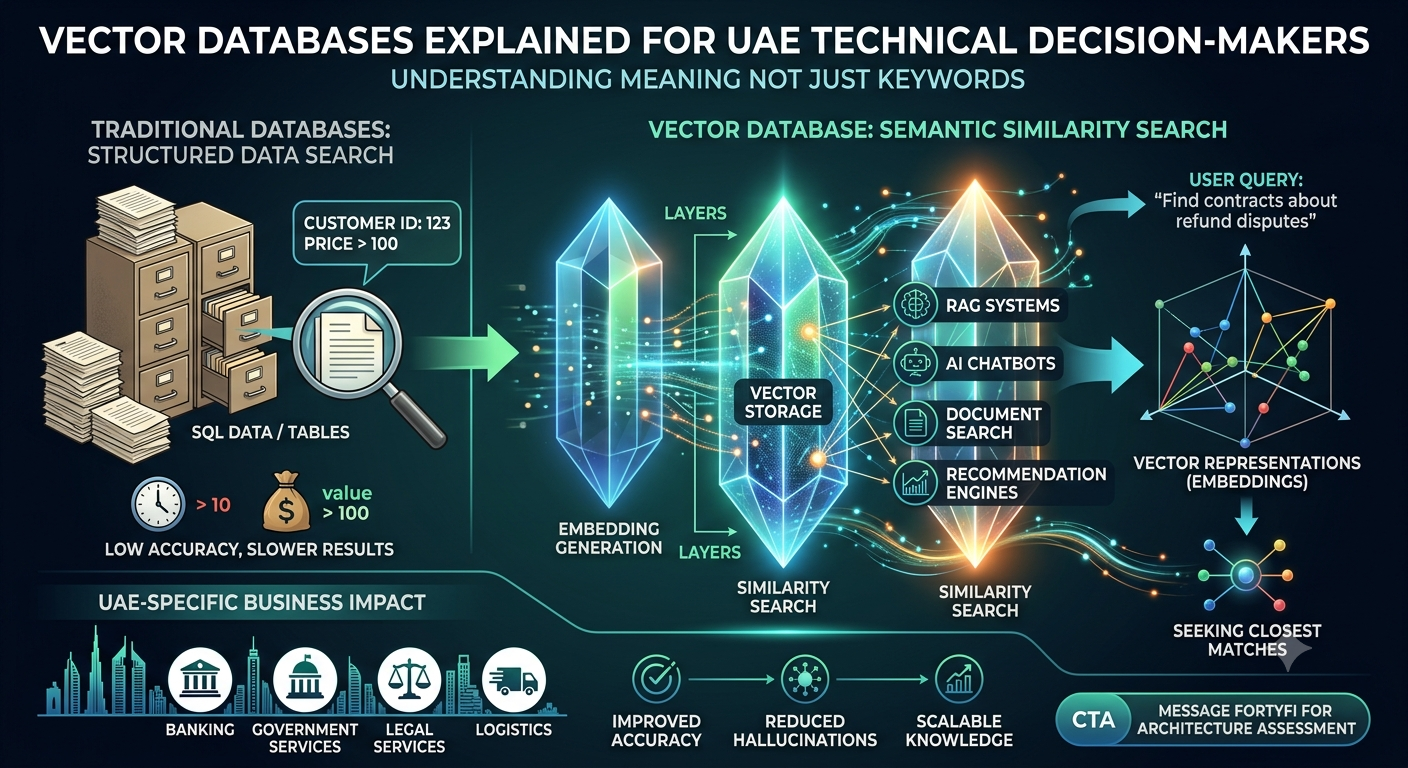
The Problem: Traditional Databases Cannot Handle Semantic Search
Traditional databases are designed for structured queries.
For example:
● “Find customer with ID 123”
● “List orders from last month”
● “Filter by price greater than 100”
These systems are precise.
But AI systems are not always precise.
They work with natural language.
For example:
● “Find contracts similar to this one”
● “Show me documents about refund disputes”
● “What did we say about pricing last year?”
Traditional databases struggle with these queries.
They cannot understand semantic similarity.
They rely on exact matches.
This creates limitations in AI applications such as:
● Chatbots
● Knowledge bases
● Recommendation engines
● Document search systems
● AI agents
The biggest challenge is meaning retrieval.
Not data retrieval.
Businesses need systems that understand similarity, not just structure.
The Solution: Vector Databases Enable Semantic Understanding
Vector databases store data as mathematical representations called embeddings.
Instead of storing text as words, they store meaning as vectors.
The first layer is embedding generation.
Text is converted into numerical vectors using AI models.
The second layer is storage.
Vectors are stored in a database optimized for similarity search.
The third layer is retrieval.
When a query is made, it is also converted into a vector.
The system finds the closest matches based on semantic similarity.
This is where AI development Dubai, LLM implementation GCC, and AI consulting Dubai
become highly valuable. Vector databases are foundational for enterprise AI systems like RAG
and agentic AI.
Common vector database use cases include:
● Semantic search
● RAG systems
● AI chatbots with knowledge grounding
● Recommendation engines
● Document retrieval systems
Key business benefits include:
● Faster and more relevant search
● Improved AI accuracy
● Better user experience
● Scalable AI knowledge systems
● Reduced hallucinations in LLMs
The strongest AI systems combine vector databases with LLMs to ground responses in real
data.
Real Numbers: Traditional Search vs Vector Database Systems
Approach Typical
Investment
Business Impact
Traditional
keyword
search
AED
100,00
0–500,
000
Low relevance accuracy
Basic vector
search setup
AED
300,00
0–1.2
M
Strong semantic retrieval
Enterprise vector +
RAG systems
AED
1.2M–
6M+
High-performance AI
knowledge systems
The numbers are clear.
Keyword systems are limited.
Vector databases unlock semantic intelligence at scale.
They are foundational for modern AI architectures.
UAE-Specific Business Considerations
For businesses operating in Dubai and across the UAE, AI adoption is rapidly moving toward
knowledge-intensive applications.
This is where agentic AI UAE and machine learning UAE become critical infrastructure
enablers.
Industries adopting vector databases include:
● Banking
● Legal services
● Healthcare
● Government services
● Enterprise SaaS
Key AI priorities include:
● Data security
● Retrieval accuracy
● Scalability
● Compliance
● Integration with LLMs
Businesses should treat vector databases as core AI infrastructure.
Not optional tooling.
Common Pitfalls in Vector Database Adoption
Despite their importance, vector databases are often misused.
Common pitfalls include:
1. Poor Embedding Quality
Weak embeddings reduce retrieval accuracy.
2. Lack of Index Optimization
Poor indexing slows down search performance.
3. No Metadata Filtering
Pure vector search without filters reduces precision.
4. Overloading the System
Large-scale data without optimization affects latency.
5. Weak RAG Integration
Without proper LLM integration, value is limited.
The solution is proper architecture design and tuning.
Why FortyFi
FortyFi helps businesses across Dubai and the UAE design and implement vector database
architectures for scalable AI systems.
From embedding pipelines and RAG system design to semantic search and AI knowledge
infrastructure, the focus is on building high-performance AI foundations.
The team helps organizations improve retrieval accuracy, reduce hallucinations, and scale
enterprise AI systems effectively.
The objective is simple: turn enterprise data into semantic intelligence.
FAQ
What is a vector database?
A database that stores data as embeddings for semantic search.
Why are vector databases important for AI?
They enable meaning-based retrieval instead of keyword matching.
Are they required for LLMs?
Yes, for most RAG-based systems.
What are common use cases?
Chatbots, search engines, and recommendation systems.
Are vector databases expensive?
Costs vary but are essential for scalable AI systems.
Is Your AI System Understanding Meaning—or Just Matching Words?
Modern AI requires semantic understanding.
Not keyword matching.
Businesses that adopt vector databases build smarter AI systems.
Message FortyFi today for a vector database architecture assessment and upgrade your AI
infrastructure.