App Development
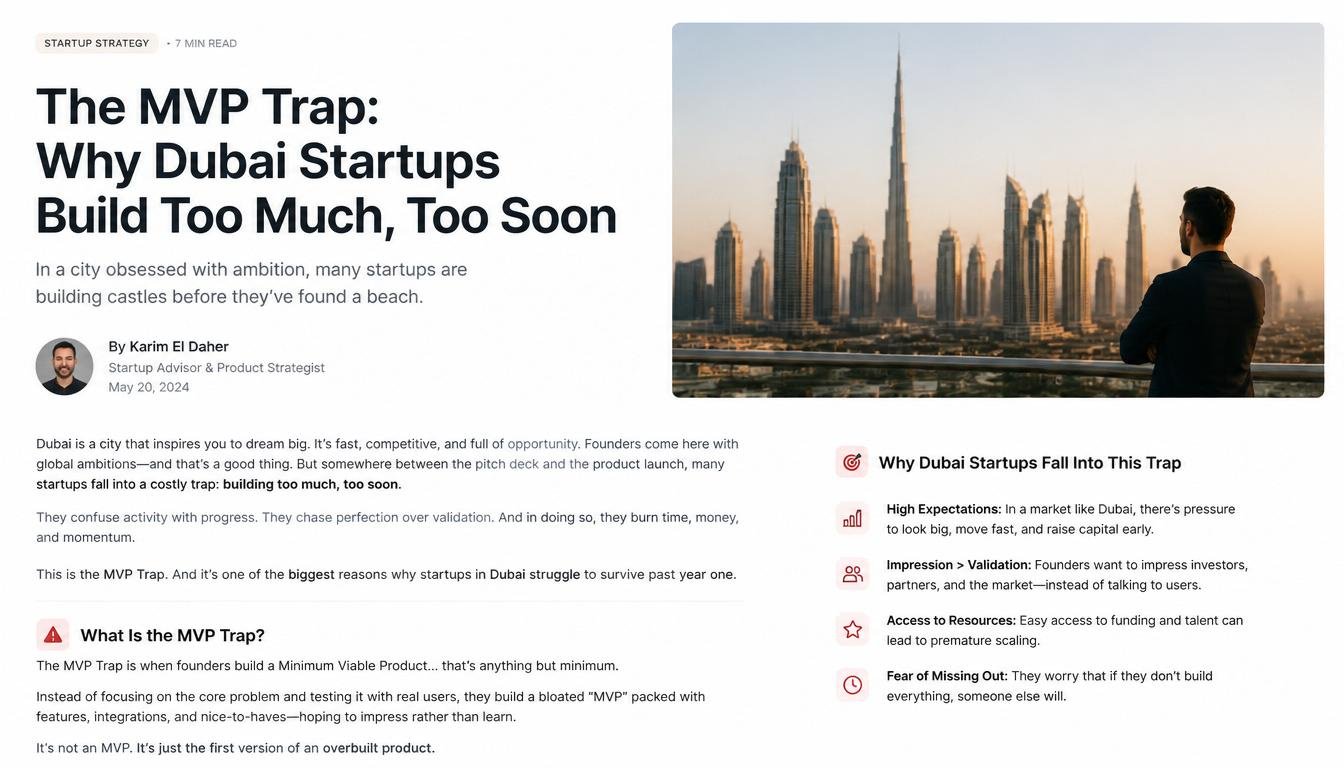
The MVP Trap: Why Dubai Startups Build Too Much, Too Soon
Jul 01, 2026
Introduction
Many startups in Dubai believe that a successful app must launch with every possible feature. This approach often leads to delays, higher costs, and confusion about what users actually need. The MVP (Minimum Viable Product) strategy exists to solve this exact problem.
The Problem
Founders often try to build a "perfect" product before launch. They add extra features, complex workflows, and advanced integrations without validating demand. This leads to: ● Increased development cost ● Delayed launch timelines ● Confusing user experience ● Higher risk of failure Most features end up unused in real-world scenarios.
The Solution
An MVP focuses only on core functionality that solves the main user problem. Instead of building everything at once, startups should: ● Identify core user needs ● Launch with minimal features ● Collect real user feedback ● Improve iteratively This approach reduces risk and improves product-market fit.
Real Numbers
Typical UAE MVP approach: ● Overbuilt app: AED 150,000 – AED 500,000 ● Lean MVP: AED 50,000 – AED 100,000 ● Iterative scaling cost: depends on user feedback Starting small can reduce initial cost by up to 60%.
UAE-Specific Security Considerations
Dubai startups operate in a fast-moving market where speed matters. Launching early helps businesses test ideas before competitors enter the space.
Why FortyFi
FortyFi helps startups build lean MVPs that focus on validation instead of unnecessary features.
FAQ
What is an MVP trap? Building too many features before validating the idea. Why do startups overbuild apps? They try to make a "perfect" product instead of a testable version. Is MVP better than full app? For startups, yes—it reduces risk and cost.
Conclusion
The MVP approach helps UAE startups launch faster and smarter without wasting resources. Need help building a lean MVP? Message FortyFi on WhatsApp for a free consultation.