Cybersecurity
The Cost of Downtime From a Cyber Attack in the UAE
Jul 01, 2026
Introduction
Most businesses calculate cyber risk the wrong way.
They focus on breach costs.
Ransom payments.
Regulatory fines.
Incident response expenses.
These costs matter.
But they often miss the most expensive impact of all.
Downtime.
When a cyber attack disrupts systems, operations can slow down or stop completely.
Revenue-generating activities pause, employees lose productivity, customer service breaks
down, and supply chains can suffer immediate disruption.
That creates massive financial pressure.
For businesses across Dubai and the UAE, downtime is often the biggest hidden cost of cyber
attacks.
Every hour matters.
Every day multiplies losses.
And the financial damage extends far beyond IT.
The question is no longer whether cyber attacks create operational risk.
The real question is how much downtime your business can realistically afford.
The Problem: Downtime Impacts Revenue, Operations, and Trust
Cyber attacks create disruption fast.
Ransomware.
System compromise.
Cloud outages.
Data breaches.
Payment failures.
All of these can trigger immediate operational downtime.
That creates severe business impact.
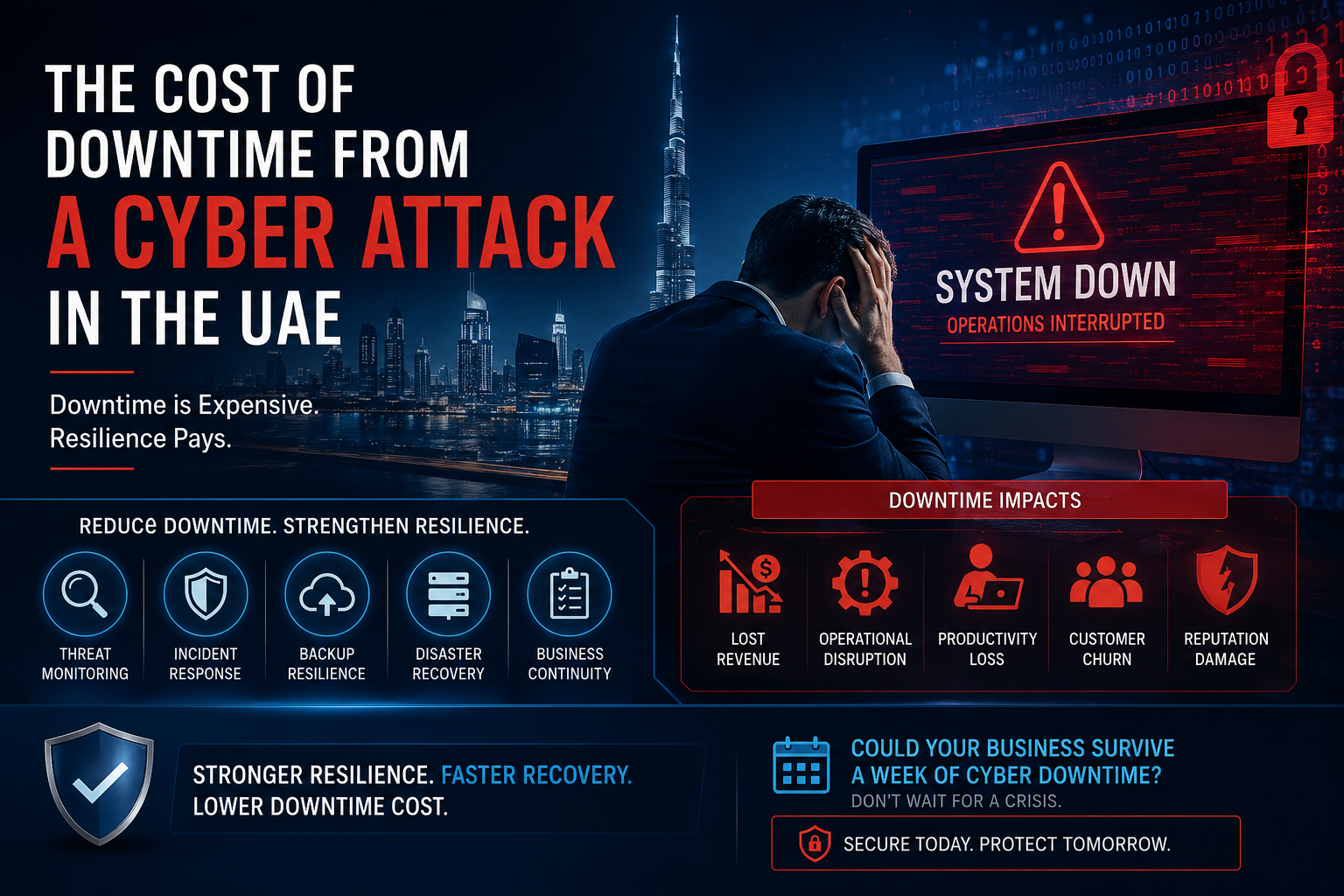
Common downtime-related costs include:
● Lost revenue
● Operational disruption
● Employee productivity loss
● Customer churn
● Reputation damage
The biggest problem is cascading impact.
Downtime affects far more than technology.
Sales slow down.
Support teams struggle.
Internal workflows stop.
Customer trust declines.
This creates business-wide consequences.
Many businesses underestimate how expensive even short downtime can be.
Hours can become costly.
Days can become catastrophic.
The Solution: Reduce Downtime Through Resilience and Recovery Planning
The strongest businesses focus on resilience.
The goal is not only preventing attacks.
It is minimizing downtime when incidents happen.
The first layer is threat detection.
Early detection reduces attack impact.
The second layer is containment.
Fast response limits operational disruption.
The third layer is recovery readiness.
Businesses need tested backup systems, disaster recovery plans, and clear incident response
procedures.
This is where cyber security Dubai strategies and SOC as a service UAE provide major
value. Continuous monitoring improves detection speed and reduces time to containment.
The fourth layer is business continuity planning.
Critical systems and workflows should have clear recovery priorities.
Key downtime reduction priorities include:
● Threat monitoring
● Incident response
● Backup resilience
● Disaster recovery
● Business continuity planning
The strongest businesses recover faster.
Recovery speed reduces financial damage.
Real Numbers: Downtime Cost vs Security Investment
Approach Typical Annual
Cost
Business Impact
Minimal resilience planning AED 0–20,000 High downtime exposure
Basic resilience program AED
30,000–100,000
Reduced downtime risk
Advanced cyber resilience
strategy
AED
100,000–300,00
0+
Faster recovery and
continuity
The financial reality is clear.
A single day of downtime can cost businesses significantly more than an entire year of proactive
security investment.
Downtime is expensive.
Resilience pays.
UAE-Specific Security Considerations
For businesses operating in Dubai and across the UAE, downtime creates both financial and
compliance risks.
Cyber incidents involving sensitive systems or customer data can impact PDPL compliance
UAE and broader data protection UAE obligations.
Key downtime resilience priorities include:
● Threat detection
● Recovery readiness
● Incident response
● Backup strategy
● Operational continuity
Businesses handling critical operations should treat downtime resilience as a strategic priority.
Operational resilience protects revenue.
Why FortyFi
FortyFi helps businesses across Dubai and the UAE reduce downtime risk through practical
cyber resilience and incident response strategies.
From threat monitoring and recovery planning to incident response and business continuity
support, the focus is on minimizing operational disruption during cyber incidents.
The team helps businesses improve visibility, strengthen resilience, and recover faster.
The objective is simple: reduce downtime before it becomes a business crisis.
FAQ
Why is downtime so expensive?
It impacts revenue, productivity, operations, and customer trust.
What causes cyber-related downtime?
Ransomware, outages, breaches, and system compromise are major causes.
Can downtime be prevented completely?
Not always, but strong resilience significantly reduces impact.
What helps reduce downtime most?
Fast detection, containment, and strong recovery planning.
Does downtime planning help compliance?
Yes. Strong resilience improves operational readiness and compliance support.
Could Your Business Survive a Week of Cyber Downtime?
Most businesses underestimate downtime risk.
The financial impact grows fast.
Businesses that strengthen resilience dramatically reduce operational disruption.
Message FortyFi today for a cyber resilience assessment and reduce your downtime risk before
the next incident.