Cybersecurity
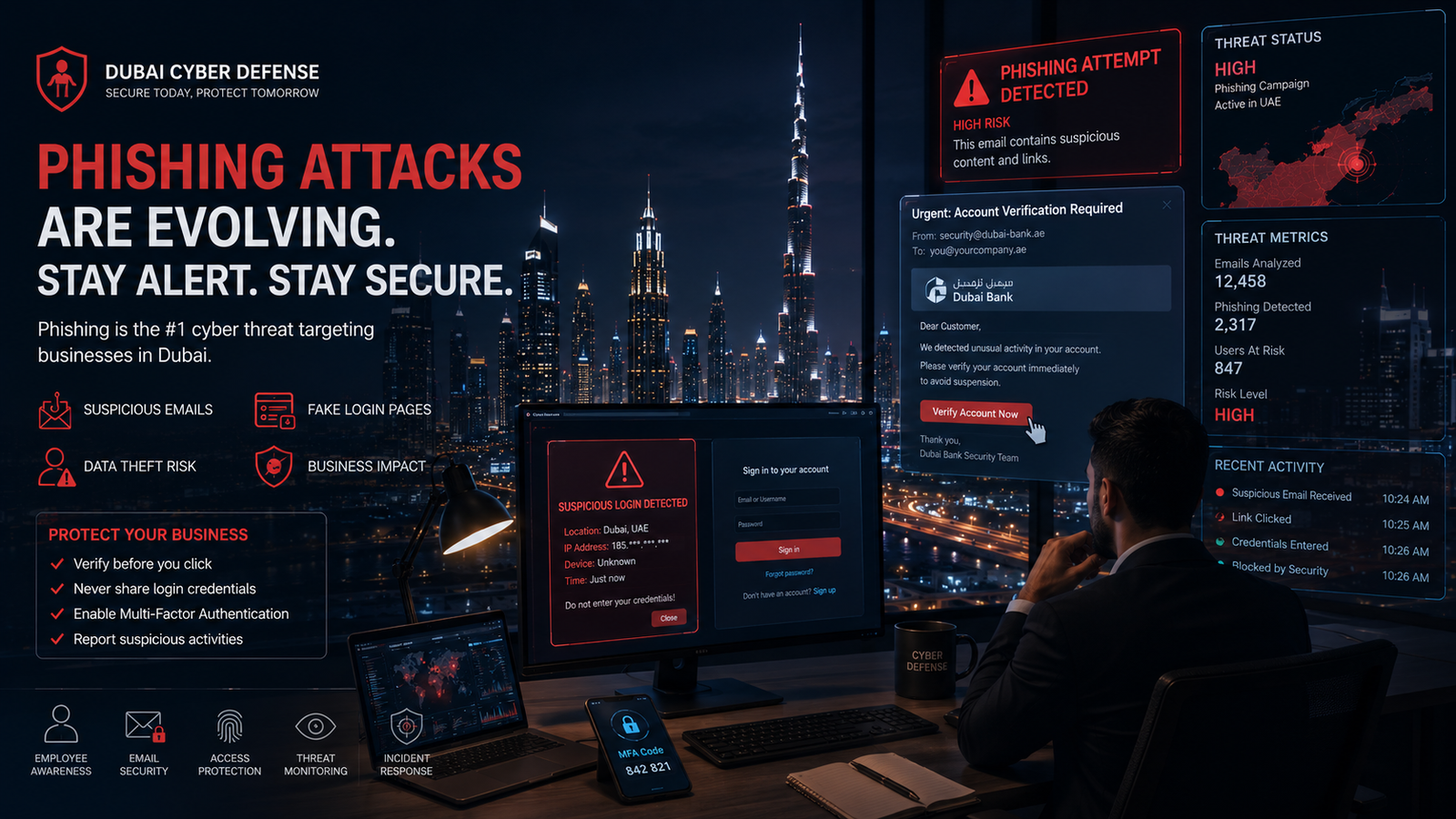
Phishing in the UAE: How Attackers Target Dubai Employees
Jun 30, 2026
Introduction
Phishing remains one of the most common and dangerous cyber threats facing businesses in Dubai and across the UAE. Despite advances in security technology, attackers continue to succeed because phishing targets the most unpredictable part of any organization—people.
That is what makes phishing so effective.
Cybercriminals no longer rely on poorly written scam emails filled with obvious mistakes.
Modern phishing attacks are highly convincing, carefully crafted, and increasingly personalized.
Employees receive emails that appear to come from executives, banks, cloud providers, logistics companies, or trusted vendors. The message looks legitimate. The branding feels familiar. The request seems urgent.
That is exactly how attackers succeed.
A single click can expose credentials, install malware, or give attackers access to critical systems.
The question is no longer whether phishing is a major risk.
The real question is whether your employees can recognize an attack before it causes damage.
The Problem: Why Phishing Attacks Keep Working
Phishing attacks succeed because they exploit human behavior.
Attackers use urgency, fear, authority, and trust to manipulate employees into making fast decisions without careful verification.
Common phishing attacks include fake password reset requests, urgent payment instructions, invoice fraud, fake Microsoft or Google login pages, and messages impersonating executives or trusted vendors.
The goal is usually one of three outcomes.
Steal credentials. Install malware. Gain access to sensitive information.
The challenge is that phishing attacks are becoming harder to detect.
Many now use AI-generated messaging, accurate branding, and highly targeted personalization.
Some attackers research employees on LinkedIn and social platforms to craft convincing messages.
For businesses in Dubai, this creates serious risk.
One compromised employee account can quickly lead to widespread damage.
The Solution: Combine Technology with Employee Awareness
The strongest phishing defence combines technical controls with human awareness.
Technology provides the first layer.
Email security filters, endpoint protection, secure authentication, and advanced threat monitoring help detect and block malicious activity before damage occurs.
This is where cyber security Dubai solutions such as email protection and SOC as a service UAE become extremely valuable. Continuous monitoring helps detect suspicious login attempts, credential abuse, and unusual user behavior quickly.
The second layer is employee awareness.
Businesses must train employees to recognize phishing attempts, verify suspicious requests, and report incidents immediately. Security awareness training should be ongoing because phishing tactics constantly evolve.
Strong authentication also matters.
Multi-factor authentication significantly reduces damage from stolen credentials by adding an extra security layer.
The best phishing defence is proactive, layered, and continuous.
Real Numbers: Prevention vs Breach Cost
Approach | Typical Annual Cost | Business Impact
No phishing protection | AED 0 upfront | High risk of compromise
Basic email security + training | AED 15,000–40,000 | Reduced phishing risk
Full phishing defence program | AED 40,000–120,000 | Strong detection and protection
The cost difference is clear.
Investing in phishing prevention costs far less than dealing with credential theft, ransomware, or financial fraud caused by successful attacks.
Even one compromised account can create major operational and financial damage.
Preparation is significantly cheaper than recovery.
UAE-Specific Security Considerations
Businesses operating in Dubai and across the UAE face increasing phishing-related risks as digital adoption grows.
Phishing incidents involving customer or employee data can create compliance concerns under PDPL compliance UAE and broader data protection UAE obligations.
This makes phishing not only a security concern but also a regulatory risk.
Key defence priorities include:
- Email security controls
- Multi-factor authentication
- Employee awareness training
- Threat detection and monitoring
- Incident response readiness
Businesses that strengthen phishing defence reduce both security and compliance risk.
Human risk remains one of the biggest attack surfaces.
Why FortyFi
FortyFi helps businesses across Dubai and the UAE build stronger phishing defence strategies through modern cyber security solutions and practical employee awareness programs.
From email security and endpoint protection to threat monitoring and incident response, the focus is on reducing phishing risk before attackers succeed.
The team helps businesses improve visibility, strengthen controls, and build more resilient security cultures.
The objective is simple: stop phishing attacks before they become costly incidents.
FAQ
Q: What is phishing?
A: Phishing is a cyber attack where attackers trick users into revealing sensitive information or performing harmful actions.
Q: Why is phishing so effective?
A: It targets human behavior using urgency, trust, and manipulation.
Q: Can phishing bypass security tools?
A: Yes. Advanced phishing attacks can sometimes bypass traditional filters, which is why layered defence is important.
Q: Is employee training necessary?
A: Absolutely. Human awareness is one of the strongest defences against phishing.
Q: Does phishing create compliance risk?
A: Yes. Data exposure from phishing incidents can create legal and regulatory consequences.
Could Your Employees Spot a Phishing Attack Today?
Phishing attacks are becoming more sophisticated, more targeted, and more dangerous.
Technology alone is not enough.
Businesses need strong security controls and informed employees.
Message FortyFi today for a phishing risk assessment and strengthen your business before attackers strike.