Cybersecurity
Network Segmentation for Dubai SMEs: A Cost-Effective Defence
Jul 01, 2026
Introduction
Many businesses across Dubai and the UAE still operate with flat networks.
Everything is connected.
Employees, servers, devices, applications, guest Wi-Fi, cloud systems, and sensitive databases
often sit in environments with minimal separation.
That creates significant risk.
If attackers gain access to one system, they can often move laterally across the network with
very little resistance.
This is exactly why network segmentation matters.
Network segmentation is one of the most practical and cost-effective cyber security strategies
available to SMEs. It reduces attack surface, limits attacker movement, and helps contain
breaches before they spread across the business.
The concept is simple.
Not every user, device, or system should have unrestricted access to everything.
The strongest businesses design networks with security boundaries.
That creates resilience.
The question is no longer whether perimeter security alone is enough.
The real question is how well your internal network can resist and contain threats.
The Problem: Flat Networks Increase Breach Impact
Many SMEs focus heavily on perimeter defenses.
Firewalls.
Antivirus.
Email security.
These controls matter.
But they are not enough.
Once attackers bypass perimeter defenses, flat networks create dangerous exposure.
An attacker compromising a single device may gain access to critical systems, sensitive data,
servers, or internal applications.
This increases breach impact dramatically.
Common network risks include:
● Lateral movement
● Ransomware spread
● Unauthorized access
● Internal compromise
● Data exposure
The biggest issue is visibility and control.
Without segmentation, businesses struggle to restrict movement between users, devices, and
critical systems.
This creates unnecessary risk.
Even a small compromise can quickly escalate into a major incident.
Attackers move faster in poorly segmented environments.
The Solution: Segment Critical Systems and Reduce Exposure
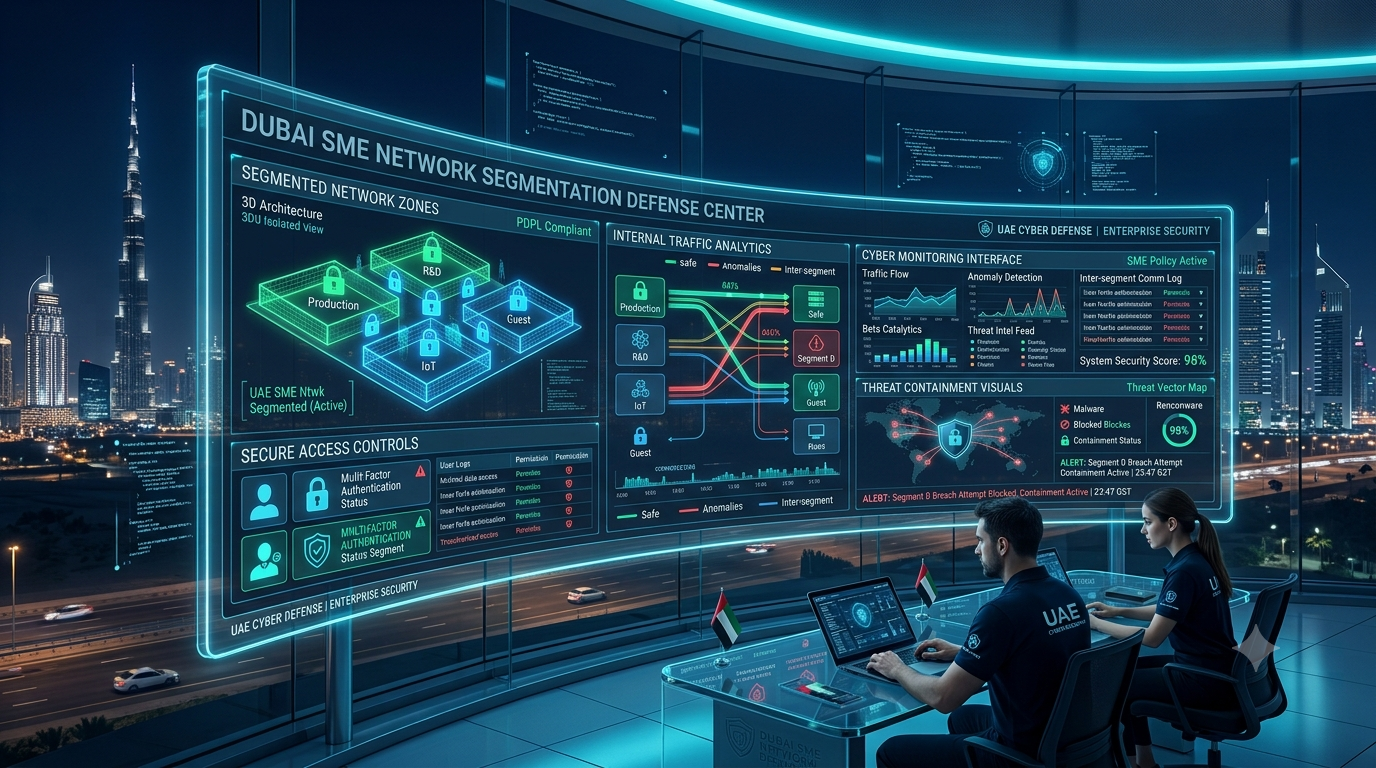
Effective network segmentation creates security boundaries inside the business.
The first step is identifying critical assets.
Businesses should identify sensitive systems such as servers, databases, finance systems,
customer data environments, and cloud workloads.
The second step is access control.
Only approved users and systems should communicate with critical assets.
The third step is monitoring.
Businesses should track unusual traffic, unauthorized access attempts, and suspicious internal
activity.
This is where cyber security Dubai strategies and SOC as a service UAE provide strong
value. Continuous monitoring improves visibility and helps identify suspicious lateral movement
faster.
Common segmentation strategies include:
● User segmentation
● Server segmentation
● Guest network isolation
● IoT device separation
● Critical workload isolation
The strongest segmentation strategies reduce blast radius.
Even if attackers gain entry, movement becomes harder.
Containment improves.
Real Numbers: Segmentation Cost vs Breach Risk
Approach Typical Annual
Cost
Business Impact
Flat network with minimal
segmentation
AED 0–10,000 High breach exposure
Basic segmentation program AED
20,000–60,0
00
Reduced lateral movement
risk
Advanced segmentation strategy AED
60,000–180,
000
Strong containment and
resilience
The economics are clear.
The cost of network segmentation is significantly lower than the financial damage caused by
ransomware spread, data breaches, and large-scale internal compromise.
Containment saves money.
Resilience reduces risk.
UAE-Specific Security Considerations
For businesses operating in Dubai and across the UAE, segmentation directly supports both
security and compliance readiness.
Weak internal access control can increase exposure to breaches affecting PDPL compliance
UAE and broader data protection UAE obligations.
Key segmentation priorities include:
● Access control
● Internal traffic visibility
● Critical system isolation
● Threat monitoring
● Incident containment
Businesses handling sensitive data should treat network segmentation as a strategic security
investment.
Internal security matters as much as perimeter security.
Why FortyFi
FortyFi helps businesses across Dubai and the UAE strengthen infrastructure security through
practical network segmentation and cyber resilience strategies.
From architecture reviews and segmentation planning to monitoring and threat response, the
focus is on reducing attack surface and limiting breach impact.
The team helps businesses improve visibility, strengthen controls, and build more resilient
network environments.
The objective is simple: contain threats before they spread.
FAQ
What is network segmentation?
Network segmentation divides networks into smaller isolated environments to improve security.
Why is segmentation important?
It limits lateral movement and reduces breach impact.
Is segmentation only for large enterprises?
No. SMEs benefit significantly from segmentation.
Does segmentation stop ransomware?
It helps contain ransomware spread and reduces overall damage.
Does segmentation help compliance?
Yes. It improves security controls and supports compliance readiness.
Could One Compromised Device Expose Your Entire Network?
Without segmentation, the answer may be yes.
Businesses that strengthen internal security boundaries dramatically reduce risk.
Containment matters.
Message FortyFi today for a network security assessment and strengthen your internal
defenses with smart segmentation.