Cybersecurity
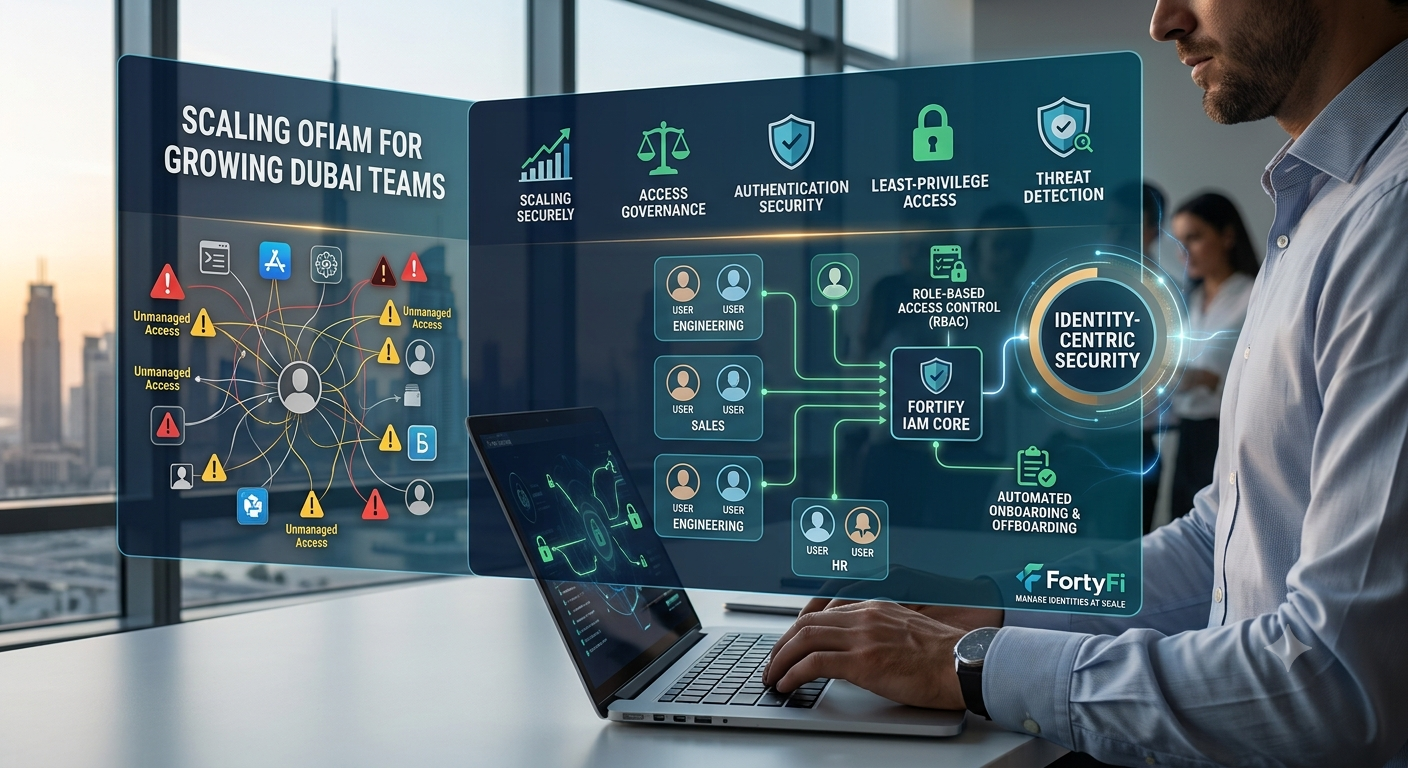
Identity and Access Management for Scaling Dubai Teams
Jul 01, 2026
Introduction
Growth creates complexity.
As businesses across Dubai and the UAE scale, teams grow rapidly.
New employees join.
Departments expand.
Systems multiply.
Cloud applications increase.
Remote work becomes common.
And every new user, device, and application adds another security challenge.
Who has access to what?
Who should keep access?
Who should lose access?
Who is monitoring permissions?
This is where Identity and Access Management matters.
IAM has become one of the most important security priorities for modern businesses.
Because attackers no longer focus only on breaking systems.
They increasingly target identities.
Compromised accounts.
Stolen credentials.
Privilege escalation.
Unauthorized access.
These are now among the most common attack paths.
The question is no longer whether identity security matters.
The real question is whether your business can control access as fast as it grows.
The Problem: Growth Often Creates Access Chaos
Fast-growing businesses move quickly.
That creates opportunity.
It also creates access management problems.
Permissions are often granted fast.
Revoked slowly.
Sometimes not revoked at all.
This creates dangerous gaps.
Common IAM risks include:
● Excessive user permissions
● Shared accounts
● Weak passwords
● Credential theft
● Poor access visibility
The biggest challenge is scale.
As teams grow, access becomes harder to manage manually.
Employees join.
Roles change.
Contractors come and go.
Applications expand.
Cloud infrastructure grows.
This creates permission sprawl.
Attackers exploit this complexity.
A single compromised account with excessive access can expose critical systems and sensitive
data.
Weak IAM creates major business risk.
The Solution: Build Strong Identity-Centric Security
Strong IAM starts with visibility.
Businesses need clear visibility into users, roles, permissions, and access pathways.
The first layer is authentication.
Strong passwords and multi-factor authentication reduce identity risk.
The second layer is authorization.
Access should follow least-privilege principles.
The third layer is continuous monitoring.
Businesses should detect suspicious login behavior, unusual access activity, and privilege
misuse quickly.
This is where cyber security Dubai strategies and SOC as a service UAE provide major
value. Continuous monitoring improves identity visibility and reduces detection time for
access-related threats.
The fourth layer is lifecycle management.
User onboarding, role changes, and offboarding should be tightly controlled.
Key IAM priorities include:
● Identity visibility
● Strong authentication
● Least-privilege access
● Continuous monitoring
● Lifecycle management
The strongest businesses secure identity at scale.
Access control reduces exposure.
Real Numbers: IAM Investment vs Breach Risk
Approach Typical Annual
Cost
Business Impact
Minimal IAM
controls
AED 0–15,000 High access risk
Basic IAM program AED
20,000–90,000
Reduced identity risk
Advanced IAM
strategy
AED
90,000–300,00
0+
Strong resilience and
visibility
The numbers are clear.
The cost of strong IAM is significantly lower than the financial and operational damage caused
by credential-based breaches.
Identity protection reduces risk.
Strong access controls improve resilience.
UAE-Specific Security Considerations
For businesses operating in Dubai and across the UAE, identity security directly affects
resilience and compliance.
Access-related incidents involving sensitive data can impact PDPL compliance UAE and
broader data protection UAE obligations.
Key IAM priorities include:
● Access governance
● Authentication security
● Threat detection
● Data protection
● Compliance readiness
Businesses managing sensitive systems should treat IAM as a strategic security priority.
Weak access controls create major exposure.
Why FortyFi
FortyFi helps businesses across Dubai and the UAE strengthen identity security through
practical IAM and cyber resilience strategies.
From access reviews and architecture assessments to monitoring and threat response, the
focus is on reducing identity-related risk before incidents occur.
The team helps businesses improve visibility, strengthen controls, and secure access across
modern digital environments.
The objective is simple: ensure the right people have the right access at the right time.
FAQ
What is Identity and Access Management?
IAM is the framework for managing user identities and access permissions across systems.
Why is IAM important?
It reduces unauthorized access and protects sensitive systems.
What is the biggest IAM risk?
Excessive permissions and compromised credentials are major risks.
Is MFA enough for IAM?
MFA is essential, but strong IAM requires broader access control and monitoring.
Does IAM help compliance?
Yes. Strong IAM improves resilience and compliance readiness.
Is Access Control Becoming Harder as Your Team Grows?
Growth creates opportunity.
It also creates access complexity.
Businesses that strengthen IAM dramatically reduce cyber risk.
Message FortyFi today for an IAM assessment and strengthen identity security across your
business.