Web3 & Blockchain
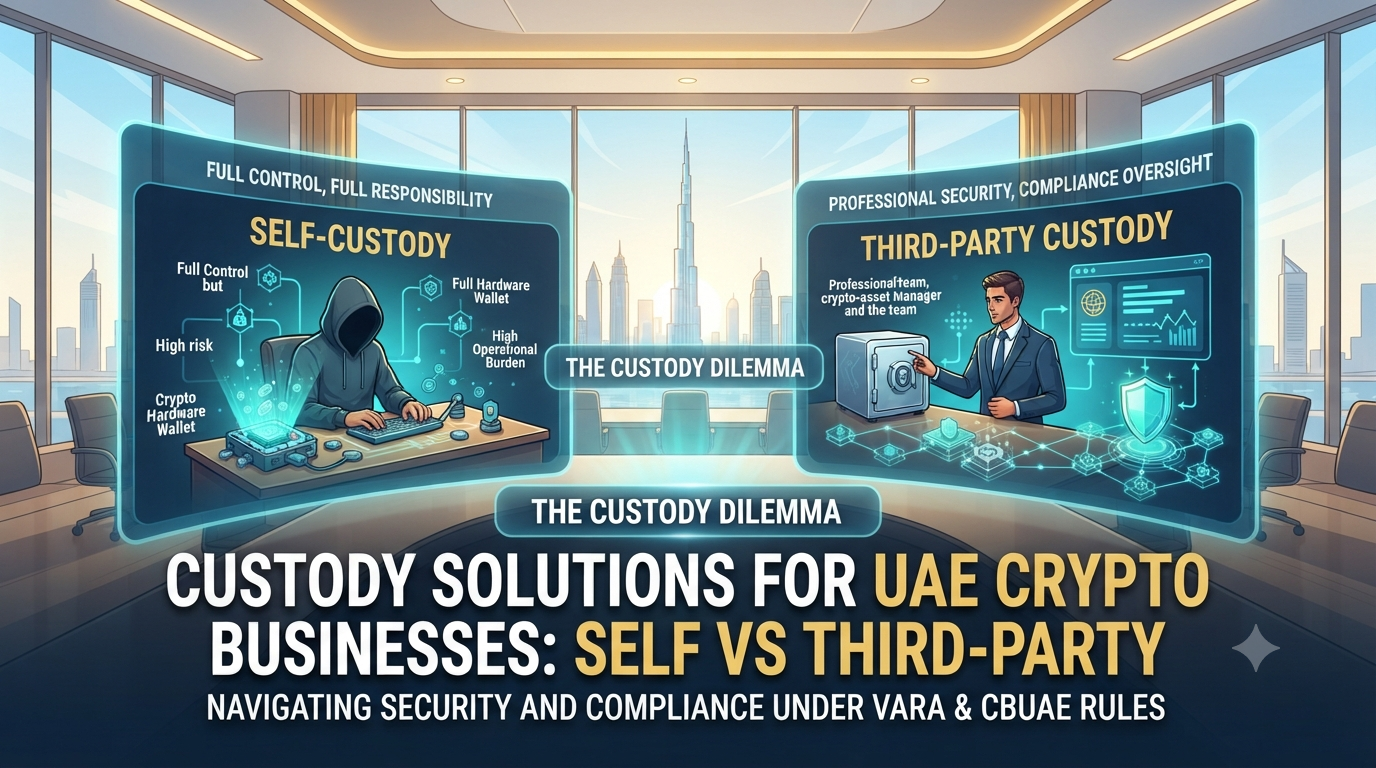
Custody Solutions for UAE Crypto Businesses: Self vs Third-Party
Jul 01, 2026
Introduction
Digital asset custody is the foundation of any crypto business. In the UAE, choosing
between self-custody and third-party custody is not just a technical decision—it's a
regulatory and risk management decision with long-term consequences .
The Problem: Control vs Security Trade-Off
Self-custody gives you full control of your private keys, but places the entire burden of
security and risk management on your team . One mistake—lost keys, phishing, or
malware—can mean permanent loss of assets . Third-party custody offers professional
security and compliance, but introduces counterparty risk and reduces your direct
control .
The Solution: Match Custody to Your Business Model
The right choice depends on your business type. For regulated VASPs (exchanges,
custodians), VARA requires licensed third-party custody with segregated client assets .
For treasury management of stablecoins or corporate reserves, third-party custody
provides bankruptcy remoteness and insurance . For smaller teams with technical
expertise, self-custody works but requires rigorous security practices. Hybrid
models—where you retain policy control while offloading signing infrastructure—are the
dominant institutional pattern in 2026 .
Real Numbers: The Cost of Getting It Wrong
Unlicensed custody activity under CBUAE can attract fines up to AED 1 billion . The UAE
Central Bank has imposed over AED 370 million in AML penalties since early 2025 .
Third-party custodians offer insurance and bankruptcy remoteness—features
self-custody cannot match .
UAE-Specific Considerations
VARA requires licensed custodians to segregate client assets from their own and
maintain strict security standards . CMA's new framework regulates custody as one of
eight licensed activities with capital requirements . Non-custodial wallet providers in
mainland UAE generally do not require SCA or CBUAE licensing, as they do not hold client
assets . For businesses in DIFC or ADGM, specific custody rules apply .
Why FortyFi
FortyFi helps UAE crypto businesses choose and implement the right custody model.
We align your custody strategy with VARA, CMA, and CBUAE requirements, and build
compliant architecture from day one.
FAQ
What's the difference between self-custody and third-party custody? Self-custody means
you control private keys directly. Third-party custody means a regulated provider holds
and secures keys on your behalf. Self-custody offers more control but carries full
security responsibility; third-party offers professional security and compliance at the cost
of some control .
Which custody model does VARA require? Licensed VASPs must use compliant
third-party custody with segregated client assets and robust security measures like
HSMs and multi-signature schemes .
Do non-custodial wallet providers need a license in the UAE? In mainland UAE,
non-custodial wallet providers generally do not require SCA or CBUAE licensing, as they
do not hold or control client assets .
Audit Your Custody Strategy
Message FortyFi on WhatsApp for a free custody consultation and compliance review.