AI & Agentic AI
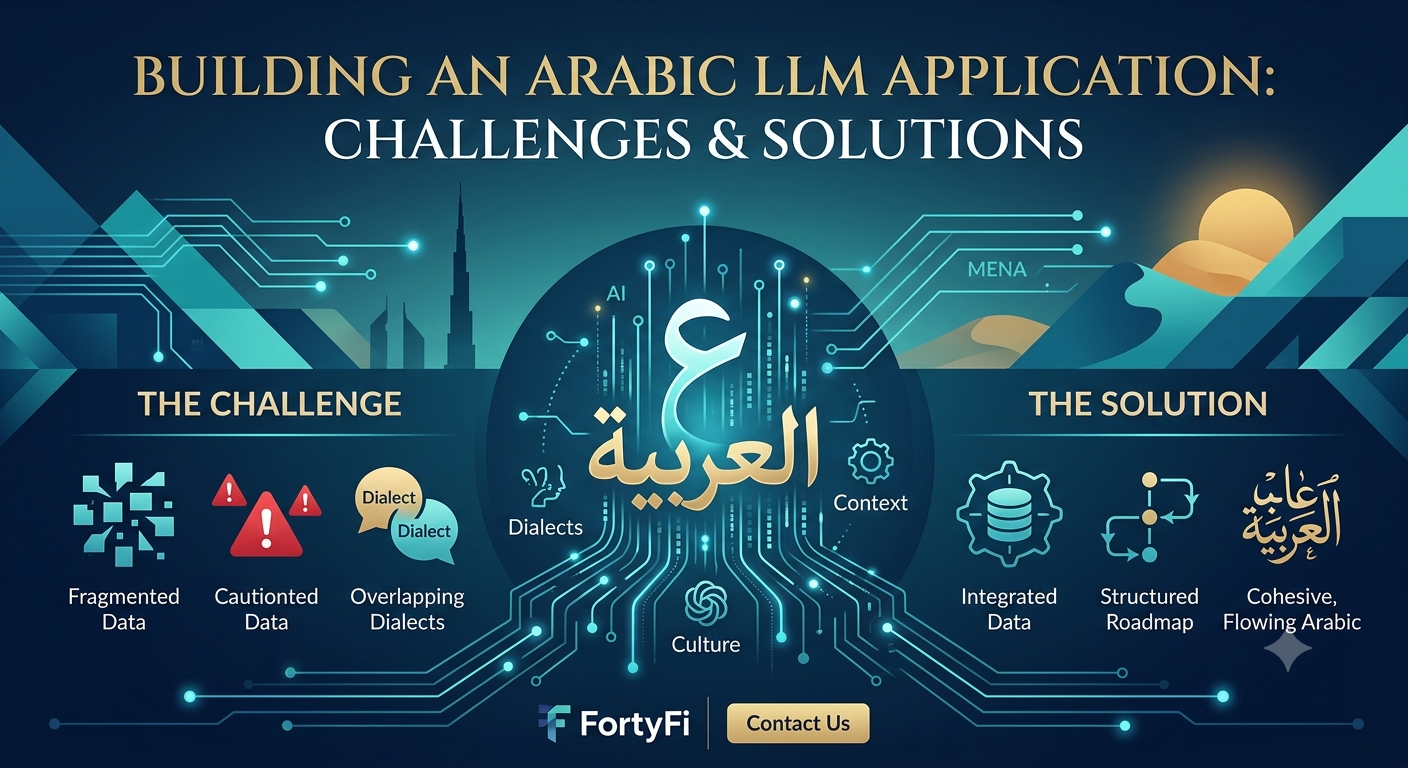
Building an Arabic LLM Application: Challenges and Solutions
Jul 01, 2026
Introduction
Arabic AI is becoming a major opportunity.
Fast.
Across Dubai, the UAE, and the wider MENA region, businesses are investing in AI to improve
customer experience, automate workflows, and scale operations.
But there is a challenge.
Most AI systems are built for English first.
That creates major limitations in Arabic markets.
Many companies assume building an Arabic AI application is simple.
Translate English prompts.
Localize the UI.
Deploy the product.
Done.
But that approach often fails.
Why?
Because Arabic is complex.
It has multiple dialects.
Regional variations.
Formal and informal usage.
Context-heavy communication.
Language alone is not the only challenge.
Culture matters too.
Intent.
Tone.
Expectations.
User behavior.
This creates a major challenge for AI adoption across MENA.
The question is no longer whether AI can support Arabic.
The real question is whether your AI application truly understands Arabic users.
The Problem: Most Arabic AI Applications Perform Poorly in Real Use Cases
Many Arabic AI deployments underperform.
Not because AI lacks capability.
Because implementation is weak.
Businesses often underestimate the complexity of Arabic language intelligence.
Common Arabic AI challenges include:
● Dialect variation
● Weak Arabic datasets
● Translation-based outputs
● Poor contextual understanding
● Cultural mismatch
The biggest challenge is linguistic complexity.
Arabic is not one uniform language in business usage.
Modern Standard Arabic may work in formal contexts.
But real users often mix dialects.
Gulf Arabic.
Levantine Arabic.
Egyptian Arabic.
English-Arabic hybrid communication.
This creates complexity for model performance.
Generic models often struggle with accuracy and context.
Weak language performance creates poor user trust.
That limits adoption.
The Solution: Build Arabic AI Systems Around Real User Behavior
Successful Arabic LLM applications require strategic design.
The first layer is language planning.
Businesses must define target dialects, language patterns, and user contexts.
The second layer is data quality.
High-quality Arabic datasets dramatically improve performance.
The third layer is architecture.
Model selection, RAG systems, and deployment strategy matter heavily.
This is where AI development Dubai, AI consulting Dubai, and LLM implementation GCC
become highly valuable. Strong implementation strategy improves Arabic AI performance
significantly.
The fourth layer is continuous optimization.
Arabic AI systems improve through real-world usage, testing, and feedback loops.
Key Arabic AI priorities include:
● Dialect support
● Strong data quality
● Context awareness
● Cultural alignment
● Continuous optimization
The strongest Arabic AI systems are built for regional behavior.
Not translated from English-first systems.
Real Numbers: Arabic AI Investment vs Business Impact
Approach Typical
Investment
Business Impact
Basic translated AI app AED
50,000
–200,000
Limited market fit
Arabic-optimized AI system AED
200,000
–1M
Strong user
adoption
Advanced Arabic enterprise
AI platform
AED
1M–4M+
Major
competitive
advantage
The numbers are clear.
Basic localization is cheaper.
But it often creates weak performance.
High-quality Arabic AI requires stronger investment.
The ROI potential is significant when execution is strong.
UAE & MENA-Specific Business Considerations
For businesses operating in Dubai, the UAE, and across MENA, Arabic AI capability is
becoming a major competitive differentiator.
Businesses that deploy AI built for Arabic users gain stronger adoption and market advantage.
This is where agentic AI UAE and machine learning UAE become critical for regional AI
leadership.
Industries benefiting most from Arabic AI include:
● Banking
● Government services
● Healthcare
● Retail
● Customer support
Key AI priorities include:
● Language quality
● Cultural alignment
● User trust
● AI performance
● Scalability
Businesses should treat Arabic AI as a strategic investment.
Strong localization creates stronger ROI.
Why FortyFi
FortyFi helps businesses across Dubai, the UAE, and MENA build practical AI systems
optimized for regional language and user behavior.
From AI strategy and Arabic LLM architecture to deployment and optimization, the focus is on
helping businesses build AI systems that truly work for Arabic-speaking users.
The team helps businesses improve adoption, performance, and AI ROI.
The objective is simple: build AI that understands your market.
FAQ
Is building Arabic AI difficult?
Yes. Arabic language complexity makes implementation more challenging than many
English-first AI systems.
Why do translated AI systems fail?
They often miss dialect, context, and cultural nuance.
Do businesses need Arabic-specific datasets?
Yes. Strong Arabic datasets improve model performance significantly.
Is Arabic AI expensive?
Costs vary based on complexity and deployment goals.
Should businesses invest in Arabic AI now?
Yes. Strong Arabic AI capability creates major competitive advantage.
Is Your AI Built for Arabic Users or Just Translated?
Translation is not enough.
Real Arabic AI requires deep localization.
Businesses that build AI for real user behavior gain stronger adoption and ROI.
Message FortyFi today for an AI strategy assessment and build your Arabic AI roadmap.