Cybersecurity
AI for UAE Healthcare: Triage, Documentation, and Patient Engagement
Jul 01, 2026
Introduction
Healthcare systems in the UAE are under growing pressure.
Patient volumes are increasing.
Administrative workloads are rising.
And clinicians are spending more time on documentation than patient care.
Across Dubai and Abu Dhabi, hospitals and clinics are actively exploring AI to improve efficiency
and patient experience.
But healthcare AI is not just about automation.
It is about safety.
Accuracy.
And trust.
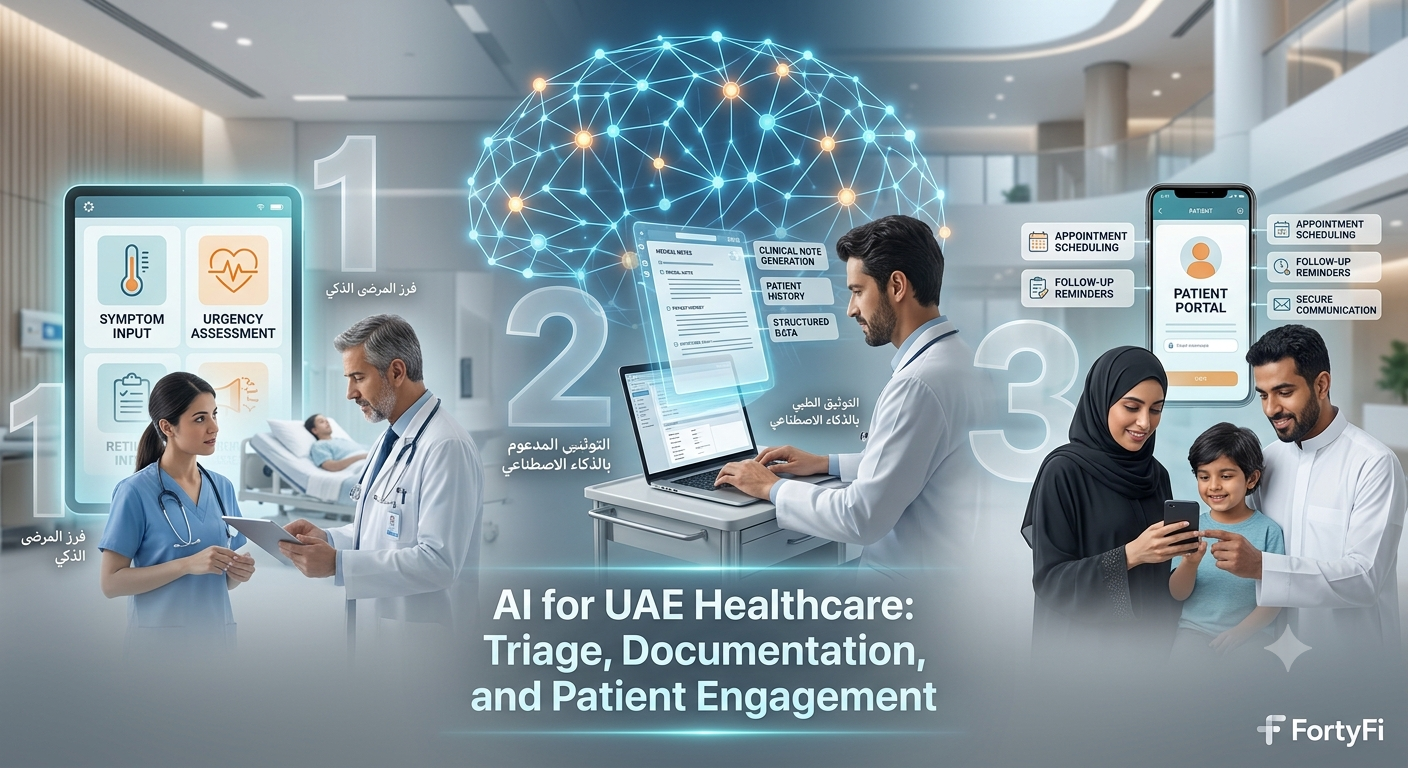
In this context, AI is being deployed in three major areas:
Triage.
Documentation.
Patient engagement.
These use cases are not experimental anymore.
They are becoming core operational layers in modern healthcare systems.
The question is no longer whether AI belongs in healthcare.
The real question is how to deploy it safely without compromising clinical quality or compliance.
The Problem: Healthcare Systems Are Overloaded With Administrative Work
Clinicians today face a growing administrative burden.
Much of their time is spent on non-clinical tasks.
Common challenges include:
● Manual patient triage
● Extensive clinical documentation
● Repetitive reporting tasks
● Fragmented patient communication
● Delayed follow-ups
The biggest issue is time allocation.
Doctors and nurses are trained for care delivery.
Not data entry.
But modern healthcare systems require both.
This creates inefficiency.
Burnout risk.
And reduced patient interaction time.
As patient demand grows, these challenges intensify.
Healthcare systems need intelligent support systems that reduce administrative load without
reducing quality of care.
The Solution: AI as a Clinical Support Layer, Not a Replacement
AI in healthcare is not about replacing clinicians.
It is about augmenting them.
The first layer is AI triage.
Systems analyze symptoms and patient input to prioritize urgency levels.
The second layer is clinical documentation.
AI assists in generating structured medical notes from consultations.
The third layer is patient engagement.
AI systems manage communication, reminders, and follow-ups.
This is where AI development Dubai, machine learning UAE, and AI consulting Dubai become
highly relevant. Healthcare AI must be carefully designed for accuracy, compliance, and safety.
Common AI healthcare applications include:
● Symptom triage assistants
● Clinical note generation
● Appointment scheduling automation
● Patient follow-up systems
● Medical knowledge support tools
Key business benefits include:
● Reduced clinician workload
● Faster patient processing
● Improved documentation accuracy
● Better patient engagement
● Higher operational efficiency
The strongest healthcare systems use AI as a support mechanism.
Not a decision-maker.
Real Numbers: Traditional vs AI-Assisted Healthcare Operations
Approach Typical
Investment
Business Impact
Manual healthcare
operations
Low tech
cost
High workload and delays
Basic AI assistance
tools
AED
300,
000–
1.5M
Moderate efficiency gains
Enterprise
healthcare AI
systems
AED
1.5M
–8M
+
Significant operational
transformation
The numbers are clear.
Manual systems limit scalability.
AI systems improve throughput and efficiency.
But must be carefully governed.
UAE-Specific Healthcare Considerations
Healthcare is one of the most regulated sectors in the UAE.
Data privacy and patient safety are critical.
This is where agentic AI UAE and LLM implementation GCC must be carefully applied under
strict governance frameworks.
Key priorities include:
● Patient data privacy
● Clinical accuracy
● Regulatory compliance
● Auditability
● System reliability
Industries impacted include:
● Hospitals
● Private clinics
● Telemedicine platforms
● Diagnostic centers
● Health insurance providers
AI in healthcare must always prioritize safety over speed.
Common Pitfalls in Healthcare AI Adoption
Despite strong potential, healthcare AI can fail if poorly implemented.
Common pitfalls include:
1. Lack of Clinical Validation
AI outputs must be verified by medical professionals.
2. Over-Automation of Clinical Decisions
AI should not replace medical judgment.
3. Poor Data Quality
Incomplete or inconsistent patient data reduces accuracy.
4. Weak Integration With Hospital Systems
Disconnected systems reduce effectiveness.
5. Compliance Gaps
Healthcare data must meet strict regulatory standards.
The solution is controlled AI deployment with clinical oversight.
Why FortyFi
FortyFi helps healthcare organizations across the UAE design and implement safe, compliant,
and effective AI systems.
From triage automation and clinical documentation tools to patient engagement systems and AI
governance frameworks, the focus is on improving healthcare efficiency without compromising
safety.
The team helps healthcare providers reduce administrative burden and enhance patient
experience through responsible AI adoption.
The objective is simple: make healthcare more efficient while keeping clinicians in control.
FAQ
How is AI used in UAE healthcare?
For triage, documentation, and patient engagement.
Can AI diagnose patients?
No. It supports clinicians but does not replace medical judgment.
Is healthcare AI safe?
Yes, when properly validated and governed.
Does AI reduce doctor workload?
Yes, especially in documentation and administrative tasks.
Is patient data secure?
It must be protected under strict healthcare and data regulations.
Is Your Healthcare System Spending Too Much Time on Administration?
Clinicians should focus on care.
Not paperwork.
AI helps reduce operational burden and improve patient experience.
Message FortyFi today for a healthcare AI assessment and modernize your clinical workflows
safely.