Cybersecurity
Agentic AI for Finance Teams: Automating Reconciliation and Reporting in the UAE
Jul 01, 2026
Introduction
Finance teams in the UAE are under constant pressure.
Close books faster.
Reduce errors.
Improve compliance.
And deliver real-time reporting to leadership.
Yet most finance operations still rely heavily on manual processes.
Spreadsheets.
Email approvals.
ERP exports.
Reconciliation checks done line by line.
This creates delays.
And increases operational risk.
Across Dubai and the wider UAE, finance transformation is accelerating.
But traditional automation is no longer enough.
Rules-based systems can only go so far.
They break when exceptions appear.
This is where agentic AI is changing finance operations.
Agentic AI does not just process data.
It executes multi-step financial workflows.
It can reconcile accounts.
Investigate discrepancies.
Generate reports.
And even suggest corrective actions.
The question is no longer whether finance should automate.
The real question is how far automation can go without losing control and compliance.
The Problem: Finance Operations Are Still Too Manual
Despite digital transformation efforts, many finance teams still rely on manual workflows.
Common challenges include:
● Delayed month-end close cycles
● Manual reconciliation errors
● Fragmented financial data sources
● Time-consuming reporting processes
● Lack of real-time financial visibility
The biggest challenge is fragmentation.
Data lives across multiple systems:
● ERP platforms
● Banking portals
● Accounting software
● Internal spreadsheets
Finance teams spend significant time matching and validating data.
Not analyzing it.
This reduces efficiency.
And increases the risk of human error.
As transaction volumes grow, manual processes become unsustainable.
Businesses need systems that can not only assist—but act.
The Solution: Agentic AI for Autonomous Finance Workflows
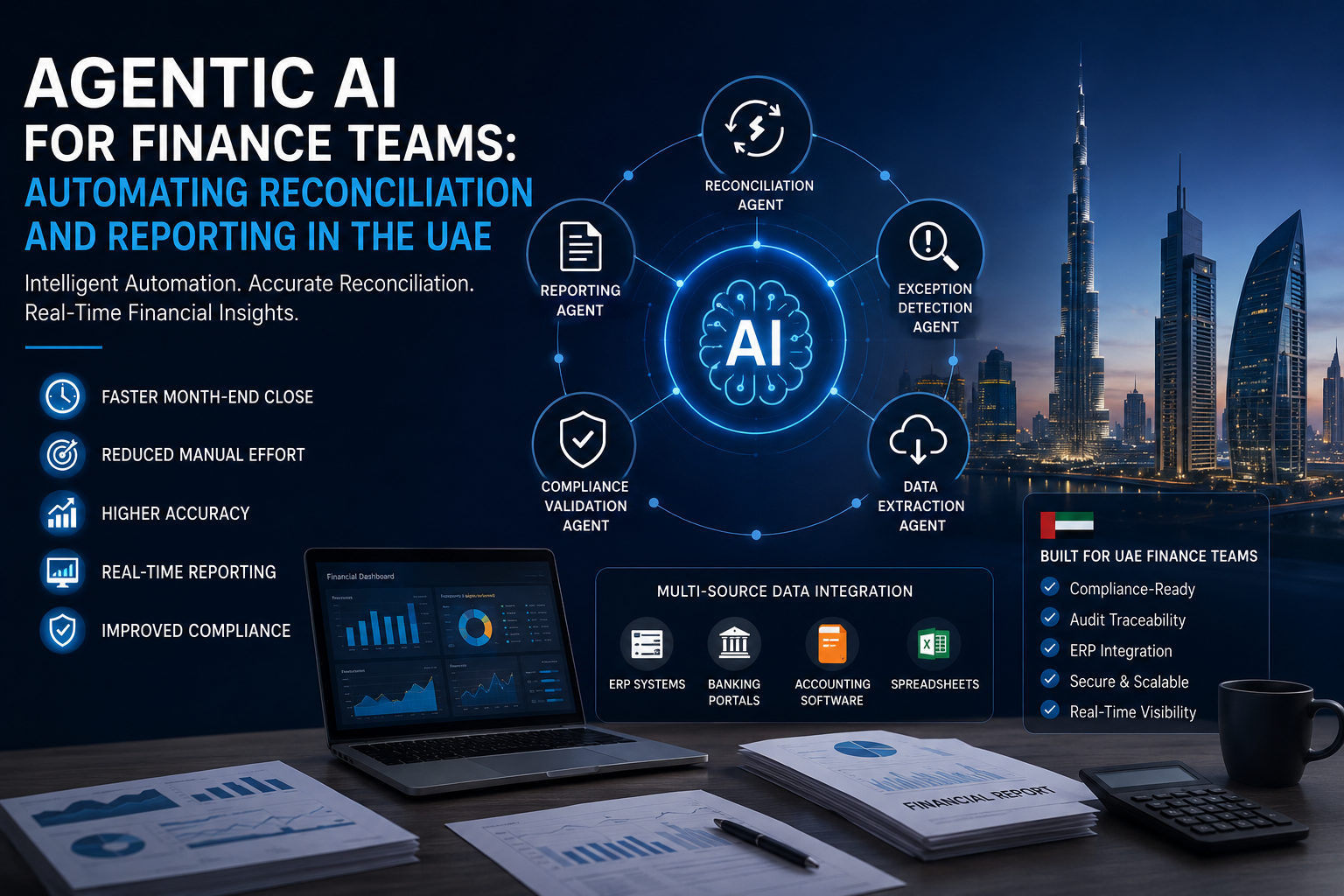
Agentic AI introduces autonomous financial workflows that operate across systems.
Instead of one AI model, multiple agents collaborate:
● Reconciliation agent
● Reporting agent
● Exception detection agent
● Compliance validation agent
● Data extraction agent
Each agent performs a specialized role.
Together, they complete end-to-end finance processes.
The first layer is data ingestion.
Agents collect financial data from multiple systems.
The second layer is reconciliation.
Transactions are matched automatically across sources.
The third layer is anomaly detection.
AI identifies mismatches and irregularities.
The fourth layer is reporting.
Automated financial reports are generated in real time.
This is where AI development Dubai, agentic AI UAE, and AI consulting Dubai become
highly valuable. Finance automation using agentic systems reduces operational overhead and
improves accuracy significantly.
Common agentic AI finance use cases include:
● Bank reconciliation
● Accounts payable/receivable automation
● Financial reporting
● Expense validation
● Audit preparation
Key business benefits include:
● Faster month-end close
● Reduced manual effort
● Higher accuracy
● Real-time reporting
● Improved compliance
The strongest finance teams are shifting from manual control to intelligent automation.
Real Numbers: Manual Finance vs Agentic AI Automation
Approach Typical
Investment
Business Impact
Manual finance
operations
Low tech
cost
High labor + error risk
Partial
automation
tools
AED
300,
000–
1.5M
Moderate efficiency
gains
Agentic AI
finance
systems
AED
1.5M
–6M
+
Major operational
transformation
The numbers are clear.
Manual processes scale poorly.
Agentic AI scales with complexity.
And reduces both cost and risk over time.
UAE-Specific Business Considerations
For finance teams in Dubai and across the UAE, regulatory compliance and audit readiness are
critical.
This is where machine learning UAE and LLM implementation GCC play an important role in
building trusted financial systems.
Industries benefiting most include:
● Banking and financial services
● Real estate groups
● Retail enterprises
● Logistics companies
● Government entities
Key priorities include:
● Compliance accuracy
● Data security
● Audit traceability
● Real-time reporting
● ERP integration
Finance leaders should treat agentic AI as an operational upgrade—not just a reporting tool.
Common Pitfalls in Agentic Finance Automation
Despite its power, agentic AI can fail if poorly implemented.
Common pitfalls include:
1. Weak Data Integration
Disconnected systems reduce automation accuracy.
2. Poor Exception Handling
AI must escalate complex cases to humans.
3. Lack of Audit Logs
Financial systems must remain fully traceable.
4. Over-Automation
Not all financial decisions should be fully autonomous.
5. Governance Gaps
Without controls, automation becomes risky.
The solution is controlled autonomy.
AI executes.
Humans oversee.
Why FortyFi
FortyFi helps finance teams across Dubai and the UAE implement agentic AI systems for
reconciliation, reporting, and financial automation.
From ERP integration and workflow design to AI-driven reconciliation engines and reporting
automation, the focus is on accuracy, compliance, and scalability.
The team helps organizations reduce manual workload and transform finance operations into
real-time intelligent systems.
The objective is simple: turn finance from reactive reporting into proactive intelligence.
FAQ
What is agentic AI in finance?
It is AI that can perform multi-step financial tasks autonomously.
Can it replace accountants?
No. It supports and enhances finance teams.
Is it safe for reconciliation?
Yes, when combined with proper governance and audit controls.
Can it integrate with ERP systems?
Yes. It works with existing financial infrastructure.
Does it reduce closing time?
Yes. Significantly in most cases.
Is Your Finance Team Still Working Manually?
Manual finance slows decision-making.
And increases risk.
Agentic AI enables real-time financial intelligence.
Message FortyFi today for a finance automation assessment and modernize your financial
operations.