Cybersecurity
78% of UAE Enterprises Had Vendor Disruptions – Don’t Be One of Them
Jun 30, 2026
Introduction
Modern businesses in Dubai and across the UAE rely heavily on third-party vendors. Cloud
providers, software vendors, logistics partners, payment processors, and outsourced service
providers now play a critical role in daily operations.
This dependence creates efficiency.
It also creates risk.
When a vendor experiences disruption—whether from cyber attacks, system failures,
compliance issues, or operational breakdowns—the impact can quickly spread across your
business. Operations slow down, customers face service interruptions, and revenue losses
begin to accumulate.
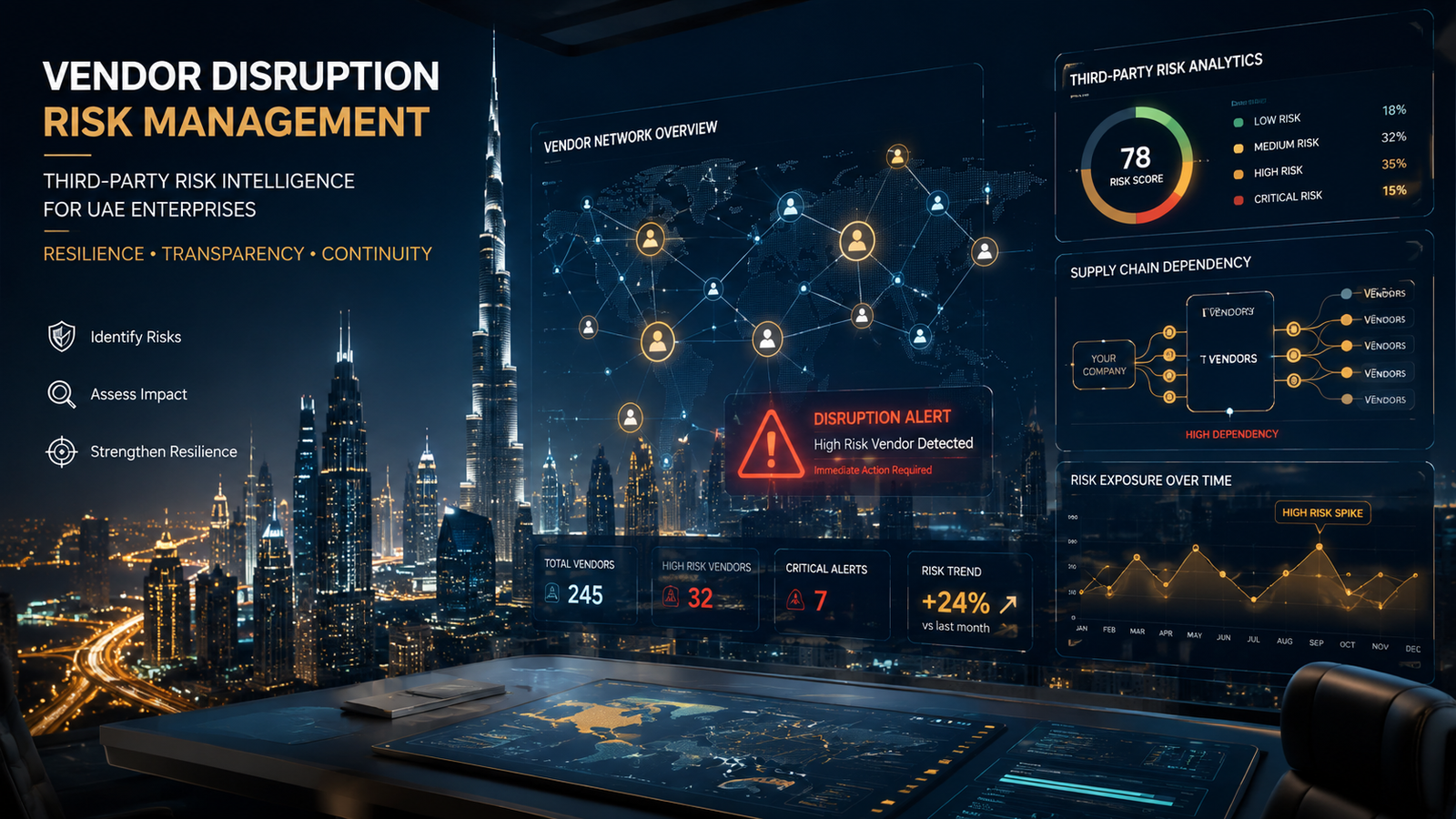
Recent data shows that 78% of UAE enterprises experienced vendor-related disruptions,
highlighting just how common this problem has become.
The reality is clear.
Your business resilience is no longer determined only by your internal systems. It is increasingly
shaped by the strength, security, and reliability of your vendor ecosystem.
The question is not whether vendor risk exists.
The real question is whether your business is prepared when disruption happens.
The Problem
Most businesses understand operational risk.
Far fewer fully understand third-party risk.
Vendors often have direct access to sensitive systems, business-critical workflows, customer
data, or infrastructure dependencies. This means a disruption at the vendor level can create
immediate consequences internally.
The risks are broader than many assume.
A vendor may experience a ransomware attack. A cloud provider may suffer downtime. A
payment processor may fail unexpectedly. A compliance issue at a third party may expose your
business to legal and reputational risk.
These disruptions can be costly.
The Solution
Reducing vendor risk starts with proactive assessment and continuous monitoring.
Businesses need to evaluate vendors not only on cost and performance but also on security,
resilience, and compliance readiness.
The first step is identifying critical vendors—those with direct impact on operations,
infrastructure, or sensitive data.
The next step is assessing risk.
This includes evaluating vendor security controls, operational reliability, incident response
readiness, and compliance posture. Vendors handling sensitive information should meet strong
cyber security Dubai and data protection UAE standards.
Ongoing monitoring is equally important.
Vendor risk changes over time. A vendor that was secure six months ago may face new
vulnerabilities or operational challenges today.
The strongest organizations treat vendor risk management as an ongoing business process, not
a one-time assessment.
Real Numbers
The numbers tell a clear story.
The cost of proactive vendor risk management is significantly lower than the financial impact of
major disruption.
Even a single vendor outage can cause losses that exceed years of preventative investment.
Preparation reduces both operational and financial exposure.
UAE Specific Considerations
Vendor risk is especially important for businesses operating in Dubai and across the UAE
because third-party failures can also create compliance challenges.
Under PDPL compliance UAE, businesses remain responsible for protecting sensitive
customer and personal data—even when that data is processed by external vendors.
This means vendor failures involving security breaches or data exposure can create regulatory
and reputational consequences.
Key vendor risk priorities include:
● Third-party security assessments
● Access control reviews
● Data handling and privacy validation
● Business continuity planning
● Incident response coordination
Strong vendor oversight improves both resilience and compliance readiness.
Third-party risk is now a strategic business concern.
Why FortyFi
FortyFi helps businesses across Dubai and the UAE build stronger vendor risk management
programs designed to reduce operational, security, and compliance exposure.
From vendor assessments and security reviews to risk monitoring and resilience planning, the
focus is on helping businesses identify vulnerabilities before disruptions occur.
The team works closely with organizations to strengthen third-party oversight and improve
business continuity.
The objective is simple: reduce vendor risk before it impacts operations.
FAQ
What is vendor risk management?
Vendor risk management is the process of identifying, assessing, and reducing risks related to
third-party vendors.
Why is vendor risk increasing?
Businesses rely more heavily on external vendors, cloud platforms, and digital service providers
than ever before.
Can vendor disruptions cause cyber risk?
Yes. Vendor failures can expose businesses to cyber attacks, data breaches, and operational
disruption.
Does vendor risk affect compliance?
Yes. Third-party security issues can create regulatory exposure, especially around sensitive
data.
How often should vendor risk be reviewed?
Critical vendors should be reviewed regularly, especially after major operational or security
changes.
How Much Risk Is Sitting in Your Vendor Network?
Third-party vendors create business efficiency—but they also create hidden dependencies.
A single disruption can impact operations, customers, and revenue.
Businesses that proactively manage vendor risk are far better positioned to withstand disruption.
Message FortyFi today for a vendor risk assessment and strengthen your business resilience
before problems arise.